
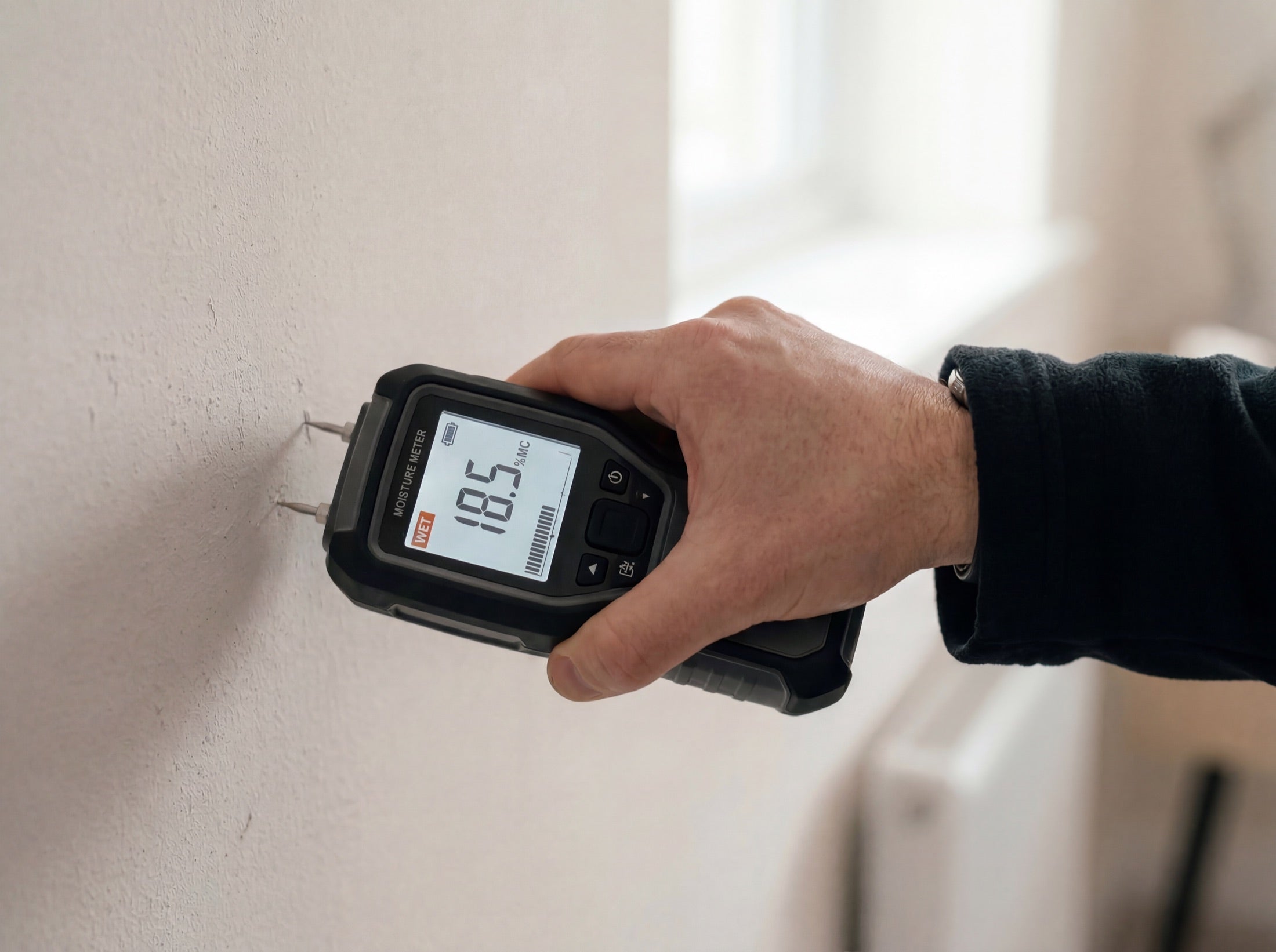
The water has to go somewhere
A washed load leaves the machine still holding one to two litres of water after a good spin. Hang it on an airer indoors and that water does not disappear. It evaporates into the room, raises the humidity, and then condenses on whatever surface is coldest — a window, an external wall, the back of a wardrobe. Mould grows where that condensation settles and stays wet.
National Energy Action's guidance on damp and condensation puts rough figures on household moisture. A family of four adds the equivalent of 30 to 40 litres of water a week to the air simply by breathing. Showering, cooking, bathing and washing add another 15 to 20 litres. Drying clothes indoors adds 10 to 15 litres a week on top of that.
Breathing is not negotiable. Indoor drying largely is — or at least, the way you do it is. That makes it the moisture source most households can actually change without spending anything.
Why it gets worse from September onwards
Two things change at the same time in early autumn. The washing stops going on the line, so more loads dry indoors. And the building fabric gets colder, so the air needs to hold less moisture before condensation forms.
This is the part that catches people out. Condensation is not really about how much water is in the air in absolute terms — it is about how close that air is to saturation at the temperature of the surface it touches. A wall at 9°C will run with water at a humidity level that leaves a wall at 18°C completely dry. Nothing about your laundry habits changed between August and November; the walls did.
It also explains why mould appears first in the same few places every year: behind furniture on external walls, in the corners of north-facing rooms, on window reveals. Cold spots condense first.
If you must dry indoors, contain it
Most people cannot simply stop drying washing indoors between October and March. The goal is not to eliminate the moisture but to keep it in one place and get it out of the building.
Use one room, and shut the door
Pick the room you can most afford to ventilate — a bathroom or utility room, not the bedroom you sleep in. Close the door while the load dries. An airer in an open-plan living space spreads that 10 to 15 litres a week through the whole floor, including into unheated bedrooms where it condenses overnight.
Run the extract, not the window, when it is cold
Opening a window in January cools the room, and a cold room condenses more readily. A bathroom extractor fan is the better tool: it removes moist air at the point it is generated and does not chill the whole space. Approved Document F, the ventilation section of the Building Regulations, sets a minimum intermittent extract rate of 15 litres per second for a bathroom and 30 litres per second for a utility room in work covered by the regulations. If your fan struggles to hold a sheet of paper against the grille, it is unlikely to be shifting anything close to that.
Leave the fan running for fifteen to twenty minutes after you have hung the load, and again periodically while it dries. Many fans have an overrun timer — use it.
Spin faster before you dry
This is the cheapest intervention available. Moving from a 1000 rpm to a 1400 rpm spin removes noticeably more water in the machine, where it goes down the drain, rather than in your bedroom, where it goes into the air. It also shortens drying time, which reduces how long the room sits at high humidity.
Give the airer room to breathe
Clothes packed tightly together dry slowly, which keeps the room humid for longer and leaves damp fabric sitting against damp fabric. Spread the load out. A load that dries in eight hours does less harm than the same load taking two days.
A dehumidifier earns its place here
If you are going to run a dehumidifier anywhere, run it in the room with the airer, with the door shut. That is the one situation where it is doing precisely the job it is designed for: removing a known quantity of water from a contained space. Put the same machine in a hallway and it will work much harder for much less.
What not to bother with
Drying clothes over a radiator is popular and counterproductive. It speeds up evaporation, which pushes moisture into the air faster, and it blocks the radiator from heating the room — so you get more water vapour and colder surfaces at the same time, which is exactly the combination that produces condensation.
Leaving a single small window on the vent latch in one room while drying in another does very little. Ventilation only works where the moist air actually is.
If mould has already appeared
Managing moisture stops new growth. It does nothing to what is already on the wall. Mould that has established on plaster or paint needs removing properly rather than wiping with a household cleaner, which tends to take the colour off the surface while leaving the growth behind — one of the main reasons black mould appears to come straight back.
Our mould removal sprays are formulated for that job on painted walls, ceilings and hard surfaces. Whatever you use, ventilate the room while you work and wear gloves and a mask; disturbing dry mould releases spores into the air.
When the laundry is not the problem
Be honest with yourself about the diagnosis. If damp is present low down on a wall in a tidemark, if plaster is blown or salty to the touch, if the problem is on one wall only regardless of what the room is used for, or if mould keeps returning within weeks of proper treatment in a well-ventilated room, then you are not looking at a laundry problem. Those patterns point towards a leak, a failed damp-proof course, penetrating damp through the external wall, or a cold bridge in the structure.
Moisture control will not fix any of those, and chasing them with dehumidifiers and open windows wastes months. Get a damp survey from someone who inspects the outside of the building as well as the inside, and who is not simply selling the remedy they happen to install.
Government guidance on damp and mould notes that the effects primarily affect the airways and lungs, and that some groups — including children, older adults, pregnant women and people with existing respiratory conditions or weakened immune systems — are more vulnerable. If that applies in your household and mould is widespread, treat it as a priority rather than a winter inconvenience, and speak to your GP if you have health concerns.
