
Two claims that are both partly right
Every autumn the same argument comes round. One side says leaving the heating on low all day wastes money and you should only heat the house when you are in it. The other says a house allowed to go cold develops damp, and a low background temperature stops it.
Both are describing something real. They are answering different questions — one about cost, the other about surface temperature — and the right answer depends on what your walls are made of.
What condensation actually depends on
Condensation is not really about how humid a room is. It is about the temperature of a surface compared with the dew point of the air touching it.
Warm air holds more water vapour than cold air. When that air meets a cold enough surface, its capacity to hold moisture drops and the excess deposits as liquid water. That is why it appears on window glass, on the corner where two external walls meet, and behind a wardrobe pushed against an outside wall — those are the coldest surfaces in the room, so they get there first.
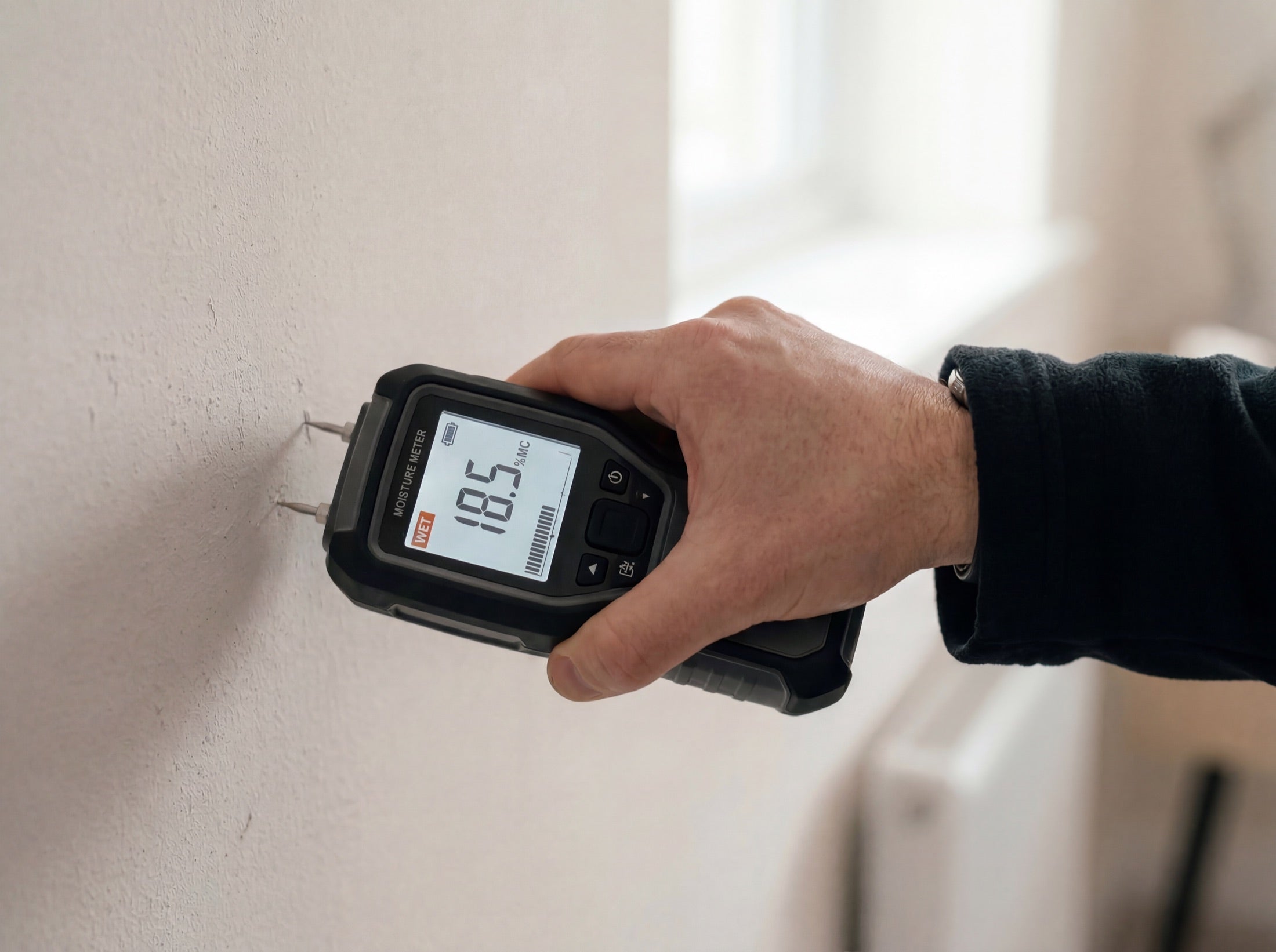
Mould does not need visible running water. In building assessments, sustained relative humidity of around 80% at the surface is commonly treated as the threshold where growth becomes likely. A wall can sit well below the point where it looks wet and still be in mould territory.
That reframes the heating question. You are trying to keep the coldest surface in the room above the dew point of the air in it. You can warm the surface, or lower the dew point through ventilation and by generating less moisture. Heating only addresses the first half.
Why constant low heat can help — and when it does not
Walls have thermal mass. A solid brick wall takes hours to warm through and hours to cool. If you heat a house hard from 6pm to 10pm and then let it go cold overnight, the air warms up fast but the wall barely responds — and overnight, while people are breathing and the air is still moist, that wall is at its coldest. That is the mechanism behind the "let it go cold and you get damp" argument, and it is genuinely how a cold-bridged corner in a solid-walled house ends up mouldy.
In a well-insulated modern house the picture is different. Internal surfaces stay much closer to air temperature, they recover quickly when the heating comes on, and the case for constant background heat largely evaporates. Here, timed heating is fine and cheaper.
So the honest version is: constant low heat helps in poorly insulated, high-thermal-mass buildings with a specific cold surface problem. It is not a general rule, and it is not free.
The cost side, plainly
Heat loss from a building is roughly proportional to the difference between inside and outside temperature. The warmer you keep the place, and the longer you keep it that way, the more heat leaks out. No arrangement of timer settings gets round that.
The Centre for Sustainable Energy puts it bluntly: do not pay for heat you are not using — if you are out during the day or asleep, you do not need the heating on. It also corrects a related myth, that turning the thermostat up makes a house warm faster. It does not. The boiler works at the same rate whether the thermostat is set to 20°C or 30°C; a high setting just means it runs longer and overshoots. CSE suggests 18–21°C as a sensible range.
The context this winter is not helping. Ofgem's price cap rises by 4% from 1 October 2026, to £1,723 a year for a typical household paying by direct debit for gas and electricity on a standard variable tariff, up from £1,663 — around £60 a year. Roughly 35% of households are on fixed tariffs and are not affected by that particular change. Either way, heating an empty house all day is a real cost, not a rounding error.
There is a floor, though
Heating is not purely optional. Public health advice in England during cold weather is to heat the rooms you use to at least 18°C, and that is stressed particularly for people over 65, people with reduced mobility, and anyone with a health condition such as heart or lung disease. Cutting the heating to nothing to control costs is not a damp strategy, and it is not a good idea for other reasons.
What to actually do
The useful middle ground is to stop thinking about the whole house and think about the specific cold surface that keeps growing mould.
- Lengthen the heating period rather than raising the thermostat. A longer, gentler run does more for wall temperature than a short blast at 24°C, and usually costs less.
- Do not close the radiator in the problem room. An unheated spare bedroom with the door shut, on an external wall, is the single most reliable way to grow mould in a house.
- Leave interior doors open between heated and unheated rooms so temperatures even out — with the exception of the bathroom and kitchen while moisture is being generated.
- Extract at source. Bathroom and kitchen fans running during and after showering and cooking remove moisture before it spreads and lands on a cold bedroom wall. Ventilation lowers the dew point, which is the other half of the equation and often the cheaper half.
- Move furniture off external walls by 5cm or so. You are not warming that surface — you are letting air reach it.
- Fix the insulation if you can. Loft insulation, cavity wall insulation where the construction allows it, or internal insulation on a stubborn cold spot raises the surface temperature permanently, which is what constant heating is trying and failing to do at a running cost.
What paint can and cannot do
Once a wall is dry and the growth has been properly removed, an anti-mould coating makes the surface less hospitable to regrowth and buys you time — our anti-mould paint range is intended for that stage of the job. What it does not do is change the temperature of the wall. If a cold external wall is still condensing every night, the underlying condition has not changed, and paint applied over live growth or a damp substrate will fail.
When to get advice
If you have adjusted heating and ventilation over a winter and one area still goes mouldy, stop treating it as a habits problem. Tide marks rising from the skirting, blown or hollow-sounding plaster, or staining that appears regardless of the weather all point at the building rather than the thermostat. A damp survey from an independent surveyor — rather than a free inspection from a firm selling one particular remedy — is the sensible next step.
