
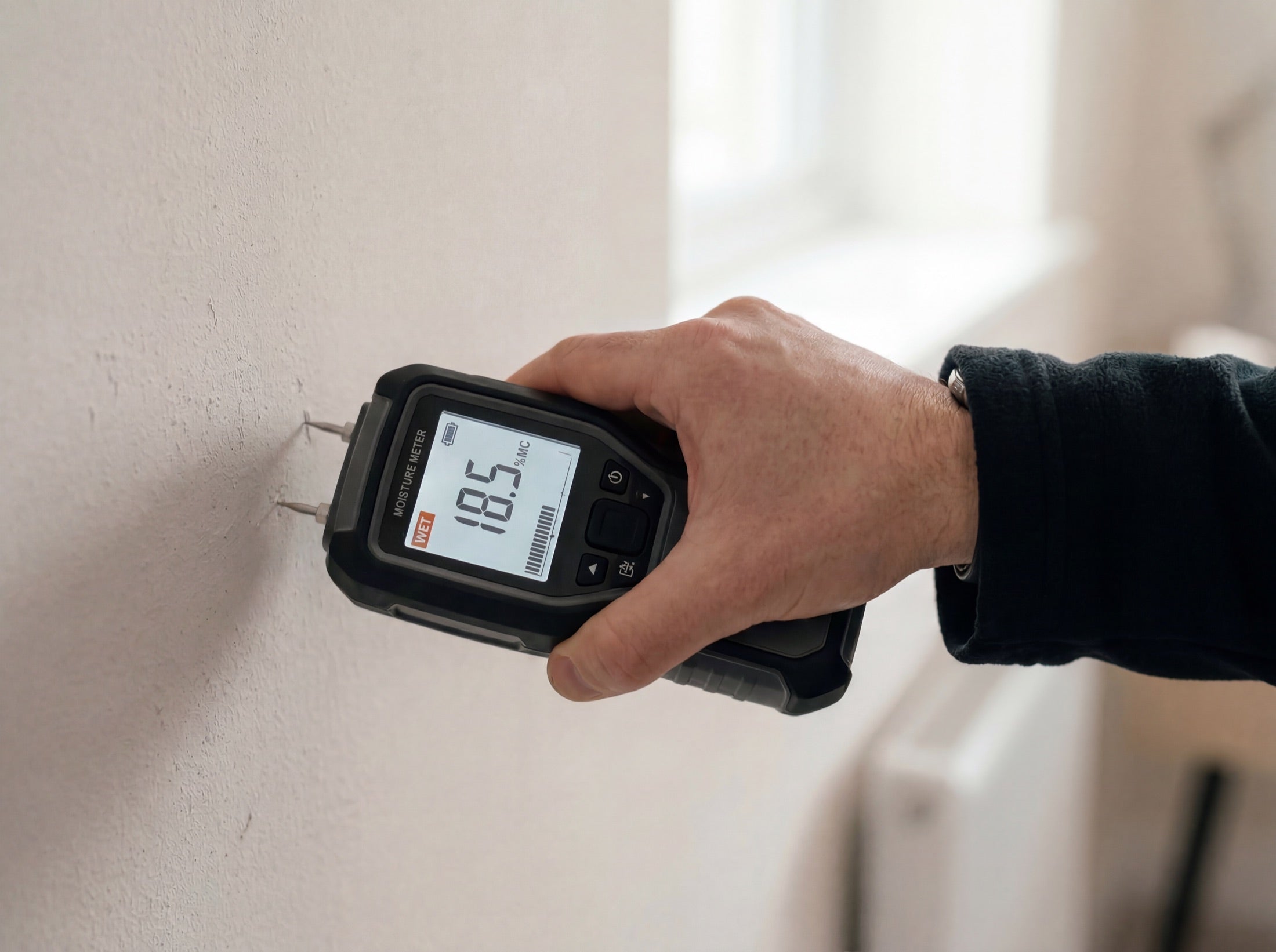
Why an empty house grows mould
A property that has been shut up since June is not resting. It is slowly equilibrating with the outdoors, and several things happen at once.
The heating is off, so the fabric of the building — walls, floors, the cold corner behind the wardrobe — drifts down towards ground and outdoor temperature. In a solid-walled Victorian terrace or a ground-floor flat, internal surfaces can sit several degrees below the air temperature for weeks.
Meanwhile the windows are shut and the extractors are off, so there is almost no air change. Any moisture already in the building — from a last-minute clean, a slow leak, damp left in a bathroom, or simply the ground under a suspended floor — has nowhere to go.
Then there is the part most people do not expect. British summer air is often warm and humid. When that air gets into a cool, unheated building, it meets surfaces that are colder than its dew point, and it condenses on them. This is why cellars, ground-floor rooms and north-facing walls can end up damper in August than in February. An empty house is not protected from damp by being empty; in some respects it is more exposed, because nobody is there to open a window or notice a stain spreading.
Add the fact that no one has been present to catch a dripping overflow, a slipped roof tile after a summer storm, or a washing machine hose weeping behind the kickboard, and a two-month void is quite enough time for a visible colony to establish.
The first day back: what to check
Before you unpack anything, walk the property with a torch and your nose. A musty smell is a real signal and it is often detectable before anything is visible.
- Behind and under furniture — the backs of wardrobes, under beds, behind sofas pushed against external walls. These are the coldest, least ventilated surfaces in the house.
- Inside built-in cupboards, particularly ones on an external wall or backing onto a bathroom.
- Window reveals, sills and the bottom corners of frames, where cold bridging concentrates condensation.
- Bathroom and kitchen sealant and grout, and the ceiling above the shower.
- Under sinks and behind the washing machine and toilet — look for staining and swollen chipboard, not just active drips.
- Mattresses and upholstery, top and underside. A mattress left flat on a slatted base in an unheated room is a classic.
- Ceilings below bathrooms and below the loft hatch, for anything that has come from above.
Photograph anything you find, with the date, before you touch it. That record is worth having whether you are the tenant, the landlord or the agent.
Getting the building dry again
The instinct on a cold, musty first night is to shut everything and turn the heating up hard. That is exactly backwards for the first few days.
Heating a cold building warms the air quickly but the walls slowly, so for a while you get warm, moisture-carrying air meeting surfaces that are still cold — which produces more condensation, not less. What you want is heat and air change together: heating on, windows on the vent or cracked open, extractors running, interior doors open so air moves through. It feels wasteful for two or three days. It is the fastest route to a dry building.
A few specifics that make a difference in the first fortnight:
- Pull furniture 5cm or so off external walls and leave it there.
- Do not fill wardrobes and drawers on day one. Air them out first — clothes put into a damp wardrobe will smell of it by week two.
- Run the bathroom extractor during showers and for a good while afterwards, not just while the water is running.
- Hold off on drying washing indoors until the building has dried out. A student house with four people and one radiator airer generates a lot of water.
- If there is a dehumidifier available, it earns its keep in these first weeks more than at any other point in the year.
Treating what you find
Deal with visible growth properly rather than wiping it and hoping. Apply a mould treatment, let it dwell for the stated time rather than scrubbing straight away, and remove the residue with disposable cloths that go in the bin. Ventilate the room and wear a fitted FFP-rated mask, gloves and eye protection — dry brushing puts far more material into the air than a wet treatment does. Our mould removal sprays are formulated for this kind of surface work on walls, ceilings, sealant and tiles.
Be realistic about what treatment achieves. It removes the growth that is there. It does not warm a cold wall, fix a broken extractor, or stop a leak. If a patch returns in the same place within weeks of a proper clean, the moisture source is still active and no product will out-compete it.
Where responsibility sits
If you are renting, the Homes (Fitness for Human Habitation) Act 2018 requires landlords to ensure the property is fit for human habitation at the start of and throughout the tenancy, and freedom from damp is one of the matters taken into account. Where that duty is breached, tenants can take legal action against the landlord through the courts.
Awaab's Law, which sets fixed timescales for investigating and acting on damp and mould hazards, came into force on 27 October 2025 and applies to the social rented sector in England. The government has said it intends to extend it to privately rented homes, but has stated it will consult on the detail and implementation timescales, and no date for that has been confirmed. So if you are in a private student let, those fixed timescales do not currently apply to you — the Fitness for Human Habitation duty does.
In practice, report it in writing, with photographs and dates, as soon as you find it, and keep the thread. Verbal reports at the door are very hard to evidence later.
When it needs a professional
Bring someone in if the affected area is large, if the damp is clearly coming from the structure rather than from condensation, if plaster is blown or hollow-sounding, if there has been flooding, or if anyone in the household has a serious respiratory condition or is immunocompromised. A void that reopens with widespread mould across several rooms usually has a building fault behind it — a failed gutter, a roof problem, a blocked airbrick under a suspended floor — and finding that is a survey job, not a cleaning job.
