
Most mould products are aimed at a surface. You find the patch, you treat the patch, you protect the patch. A fogger works differently: it treats the room rather than a spot on the wall, which makes it a useful finishing step and a poor substitute for the surface work that comes first.
What a total-release fogger is
A total-release aerosol fogger empties its entire contents in one go as a fine mist that disperses through the room. There is no trigger to squeeze, no cloth, and no wiping. You place it, activate it, leave, and let it work.
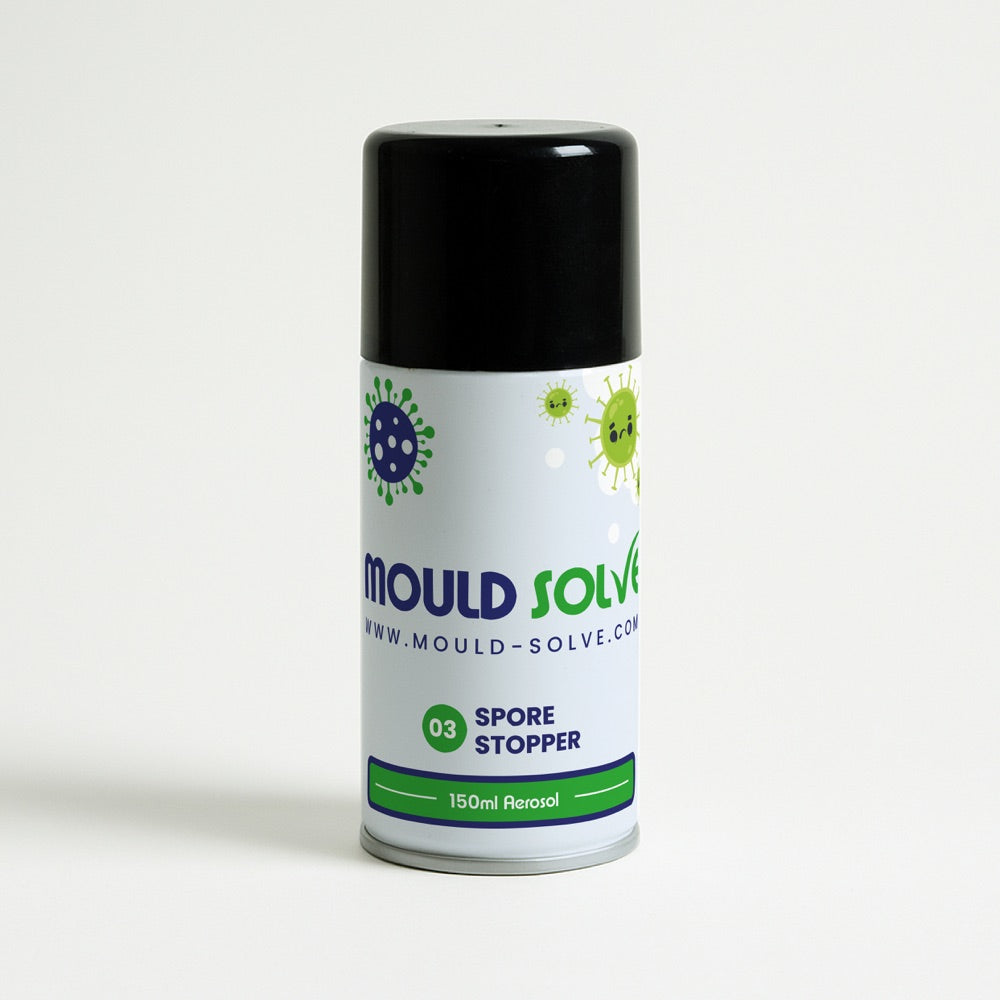
!Mould Solve Spore Stopper Mould Fogger 150ml
Spore Stopper Mould Fogger 150ml is a professional total-release fogger that helps reduce airborne mould spores and refresh rooms affected by damp, condensation and musty odours. One-touch activation treats the whole room, and it covers rooms up to 60m³.
Why the room matters as well as the wall
Treating a mould patch disturbs it. Scrubbing, spraying and wiping all release material into the air of the room you are standing in. That is why the surface can end up clean while the room still smells, and why the air side of the job is worth thinking about separately.
A fogger addresses that room stage. It is not doing the same job as a spray, and it does not replace it.
Where it fits in the sequence
The order matters more than the products.
- Find the cause. Condensation, a leak or a defect. Nothing else works until this is understood.
- Remove the visible growth on the surface, using Mould Removal Sprays.
- Let the surface dry properly.
- Treat the room with a fogger as a finishing step.
- Protect the surface if you are redecorating, using Mould Prevention & Primers and Anti-Mould Paint.
- Fix the conditions so it does not come back.
Step four is where Spore Stopper belongs: after the surface work, not instead of it. The Mould Treatment Kits that include foggers follow this same order, pairing the two-stage surface treatment with the room stage.
What it does not do
Being clear about this saves disappointment:
- it does not remove mould from a wall, so visible growth still needs treating on the surface
- it does not fix a leak, a roof defect or rising damp
- it does not replace ventilation, heating and moisture control
- it does not make a permanently damp room dry
If the room has an ongoing moisture problem, a fogger treats the symptom of a still-damp room and the problem returns. See why mould keeps coming back after cleaning.
How to use it
The method is deliberately simple:
- Clear the room of people, pets, plants, food and open drinks
- Close the windows and doors so the mist stays in the room
- Place the can centrally in the room, on a stable surface, clear of soft furnishings
- Press the one-touch activator
- Leave the room immediately and keep it closed
- Allow the fine mist to disperse for the time stated on the can
- Ventilate afterwards as directed on the can before using the room normally
Always follow the directions on the can itself, including the timings, clearance requirements and any surface precautions. Cover or remove anything you would not want a fine mist settling on, and take the usual aerosol precautions around ignition sources.
Working out whether one can is enough
Spore Stopper covers rooms up to 60m³. That is a volume, not a floor area, so the ceiling height matters as much as the footprint.
Multiply length by width by height in metres. For a standard 2.4m ceiling:
- a 3m × 3m bedroom is about 22m³, comfortably within one can
- a 4m × 3.5m bedroom is about 34m³, within one can
- a 5m × 4m living room is about 48m³, within one can
- a 7m × 4m through lounge is about 67m³, which exceeds one can
- a room with a 3m ceiling needs recalculating, since height adds up quickly
Rooms with high ceilings, converted lofts, open-plan spaces and knocked-through receptions are the ones that catch people out. Measure before you buy rather than after.
When you need more than one can
A single can suits a single normal-sized room, treated once. You will need more than one when the job is bigger than that:
- More than one affected room. Condensation problems rarely stop at one door. A bedroom, a bathroom and a landing is three rooms, not one.
- A room larger than 60m³. Open-plan and through rooms need treating as the volume they actually are.
- Repeat treatment. Some situations benefit from treating again later in the season rather than once and hoping.
- Rental turnarounds. Landlords and agents treating between tenancies get through them steadily, and keeping a few on the shelf beats ordering per property. See the landlord and property manager checklist.
- Seasonal use. Treating problem rooms going into autumn and again later in winter, as covered in getting your home ready for autumn and winter mould season.
- After a leak or flood dry-out, where several rooms were affected and the drying has finished. See mould after a leak or flood.
It is worth working out the total before you order, so you are not part-way through a job when you discover the room is bigger than one can covers.
Order as many as the job needs from Spore Stopper Mould Fogger 150ml.
Rooms it suits
- bedrooms and bathrooms after surface treatment
- rooms with a persistent musty smell, as covered in why a room smells musty
- properties that have been empty or closed up
- rooms being turned around between tenancies
- spaces where a full surface treatment has just been carried out
Safety points worth repeating
- keep people, pets and plants out of the room during treatment and until it has been ventilated
- remove or cover food, drinks and food preparation surfaces
- do not use it in a room you need to stay in
- follow the can's directions for timing and ventilation exactly
- take the standard aerosol precautions, including keeping it away from ignition sources
- store out of reach of children
There is more on working safely through a treatment in safety when removing mould.
FAQs
Does a fogger remove mould from the wall?
No. It treats the room rather than the surface. Visible growth still needs treating directly, and the fogger is the finishing step afterwards.
How many cans do I need for a whole house?
Work it out room by room using length × width × height, and count each room separately. One can covers up to 60m³, so most standard rooms need one and large or open-plan spaces need more.
Can I stay in the room while it works?
No. Set it off, leave immediately, keep the room closed for the time stated on the can, and ventilate before going back in.
Will it stop the mould coming back?
Not on its own. Recurrence is driven by moisture, so ventilation, heating and dealing with the cause are what prevent it returning. See why mould keeps coming back after cleaning.
Is it the same as an air freshener?
No. An air freshener adds fragrance. Spore Stopper is a total-release treatment that helps reduce airborne mould spores and refresh rooms affected by damp, condensation and musty odours.

